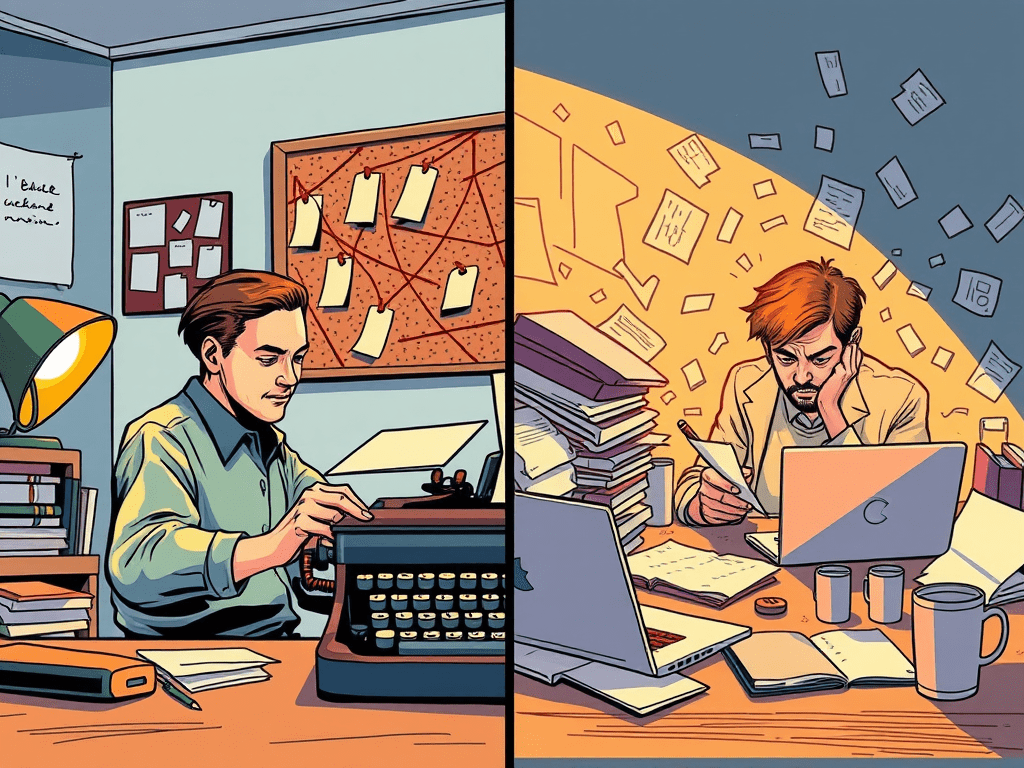
There’s this moment every writer hits at some point: that creeping feeling that your story is falling apart halfway through. Maybe you started strong. Maybe you even know how it ends. But suddenly, the middle becomes a slog. Characters lose their direction. Scenes go nowhere. You’re stuck.
That’s exactly where I was with Welcome To Tucson.
When I decided to take Welcome To Tucson from the television show script format that it was in and turn it into a novel, I only had about half a novel’s worth of material—and the ending wasn’t great. I actually thought I could write it by winging it, and for a while, I convinced myself that was working. But the truth is, I kept getting stuck.
I’d write a scene I liked, then stare at the blinking cursor for three days because I had no idea what was supposed to come next. That’s when I finally turned to outlining.
And I’ll be honest—it changed everything.
Why You Actually Need an Outline
I used to think outlining would ruin the creative flow. Like it would box me in or take the magic out of discovering the story as I went. Turns out, an outline does the opposite—it gives you a clear path to explore, so you’re not wandering in circles trying to find your plot.
Here’s what outlining actually did for me (and can do for you):
- It showed me what I already had. I dropped the scenes and story beats I had onto paper—even the unfinished ending idea—and saw that there was a shape there. It just needed connection.
- It made it easier to write the missing pieces. Once I saw the gaps between the key moments, I could ask: “What needs to happen here to get from Point A to Point B?”
- It saved me from backtracking. Plot holes, dropped characters, pacing problems—those are a lot easier to spot when you’re not in the weeds of prose.
Think of it like this: outlining is not the enemy of creativity—it’s a map. And sometimes, it’s the only thing keeping you from getting lost in the woods of your own story.
What a Good Outline Actually Looks Like
Okay, so you’re sold on outlining. Now what? You don’t have to make it fancy. You don’t even have to make it pretty. But you do need to make it work for your brain.
Here’s what a strong, functional outline should include:
- Opening Hook – The first moment that grabs attention.
- Inciting Incident – The event that disrupts the status quo and kicks off the story.
- Key Plot Points – Major turns, reveals, or choices that move the story forward.
- Climax – The peak of conflict where everything comes to a head.
- Resolution – What’s changed? What’s left behind?
- Character Arcs – How each major character evolves across the story.
- Subplots – Secondary threads that support (or challenge) the main plot.
- Themes – What you’re really trying to say under all the action and dialogue.
And that’s just a baseline. You can go deeper if you want, adding scene breakdowns, beats, or even snippets of dialogue.
Approaches to Outlining (Pick Your Poison)
There’s no right way to outline—just the way that works for you. Here are a few popular methods:
The Classic Three-Act Structure
- Act I: Setup, character introductions, and inciting incident.
- Act II: Rising tension, complications, and a major midpoint twist.
- Act III: Climax and resolution. This one’s great if you’re newer to outlining or just need structure to bounce ideas off of.
The Beat Sheet (a la Save the Cat)
A more detailed scene-by-scene breakdown. Beats include:
- Opening Image
- Catalyst
- Midpoint
- All is Lost
- Final Image It helps with pacing and emotional rhythm, especially in character-driven stories.
The Snowflake Method
Start small (a one-sentence story summary) and build outward, step by step, until you’ve got full scenes. Ideal for logical thinkers who like systems.
Visual Mapping
Use mind maps, sticky notes, or digital whiteboards to connect scenes and ideas. I’ve used this when a story felt too jumbled to see linearly.
Real Talk: What My Outline Did for Welcome To Tucson
Once I started filling in the beats I already had—from opening to halfway through—I plugged in that half-baked ending idea and just… connected the dots. That’s it.
I wasn’t forcing anything. I was simply asking, “What would actually have to happen to get us from here to there?” And that’s when things got easier. Scenes came faster. Motivations clicked. I even discovered new moments I never would have found by pantsing it.
The best part? I finished the book.
That’s the power of a solid outline. It doesn’t replace creativity—it clears the road so creativity can do its thing.
Don’t Let the Word “Outline” Scare You
You don’t have to be hyper-organized or type-A to use an outline. You just need to give your story a skeleton to hang on.
You can sketch it on a napkin. You can make a spreadsheet. You can dictate it into your phone during a midnight coffee-fueled idea spiral. It doesn’t matter.
What matters is having a bird’s-eye view of your story—so when you’re deep in Chapter 12 wondering why is this character even here, you can scroll up, look at your map, and say, “Right. They’re here to do this. Let’s go.”
Quick Tools You Can Try
Here are a few outlining tools I’ve tried or recommend checking out:
- Scrivener – Scene cards, folder organization, and research all in one.
- Plottr – A visual timeline tool built for novelists.
- Google Docs/Sheets – Free, flexible, and perfect for collaborative outlines.
- Milanote – A great visual tool if you think in flowcharts or mind maps.
- Index Cards/Whiteboards – Seriously underrated.
Final Thoughts
If you’ve ever hit a wall in your writing, it might not be writer’s block—it might just be a missing outline.
Outlining doesn’t kill the magic. It creates the space for the magic to happen.
So whether you’re starting your first novel or trying to untangle a story mid-draft, take the time to sketch it out. Trust me—I learned the hard way that winging it only gets you so far. Outlining got me to the finish line.
And it can do the same for you.
Want to see a real example of how I outlined Welcome to Tucson? Let me know in the comments—or shoot me a message.
 Bradley Page aka Producer Rage
Leave a comment